


Tim Tasioulas, a veteran in the structural steel fabrication industry, was walking through his paint bay which is a habit, he says, more than a formal inspection. He was eyeing paint quality when something caught his attention on one of the angles. He reached down to brush it away. His nail sank into a crack.
That small, almost accidental discovery in 2021 would spiral into one of the most costly and complex crises of his professional career.
A project going wrong in the background
The project had started well enough. It was early January 2021, and Tim’s company was one of four or five contractors working on the same large site, each fabricating and erecting buildings of roughly 1,000 to 1,500 tonnes. By the time the crack appeared, they had around 300 tonnes in the air, 300 tonnes on site, 300 in fabrication, and another 300 still in production.
The steel angles used in the structural trusses spanning up to 30 m had been procured from two suppliers. It arrived with certificates. It was sold as S355 graded steel. There was no obvious reason to question it.
But when third-party independent testing came back, the results were alarming: high carbon content. The steel did not meet the grade it had been sold as.
The problem wasn’t with secondary members. It was in the chords, the top and bottom members of the trusses bearing the full load of the structures. Some of that steel had already been erected.
The true cost of bad steel
The immediate financial hit was significant. Third-party testing alone cost close to R500,000. But that, as Tim puts it, was “the smallest of our problems.”
Work stopped completely on site and in the workshop while the investigation was conducted. Every tonne of fabricated steel had to be assessed. Independent inspectors were sent up to test material that was already erected. Trusses that failed had to come down. And then the real challenge began: figuring out what to do with structural steel that had already been cut, welded, plated, and assembled.
“Replacing a top chord once it’s in a truss with all the vertical members, diagonals, and plates framing into it is almost impossible,” Tim says. “You can’t just cut it out and slot in a new one.”
When the mill owners arrived on site, they initially challenged the traceability of the material. A tense moment followed, until Tim’s team lifted one of the bundles and found a different bundle beneath it. The mill rep confirmed that one was theirs. It was proof of the issue, but it didn’t solve the underlying problem.
The mill offered to replace the raw material. But by then, the raw material represented perhaps a third of the total cost per tonne. The fabrication, delivery, and erection layered on top of it made replacement offers almost meaningless against the actual losses.
A systemic problem, not an isolated incident
Tim is clear that what happened to his company wasn’t an anomaly. It reflects something deeper happening across the South African steel supply chain.
The departure of Mittal’s Newcastle Works, which shut for upgrades during this period and has since fundamentally altered the local supply landscape, left a gap that the market is still struggling to fill. Section sizes that were once standard are now in short supply or no longer produced locally. PFC sections, RST sections, larger columns and beams: many are now imported, sourced from mills with varying and largely unknown quality standards.
“I now understand the four or five mills in South Africa and what their capabilities are,” Tim says. “But the merchants I buy from are sourcing from twenty mills around the world. I have no knowledge of their levels of quality.”
This isn’t simply a theoretical concern. Tim’s company now routinely sends received material for third-party testing on certain projects, not because it is standard practice, but because the shortage in the market has forced them to look at mills they wouldn’t previously have considered. When there’s no alternative, you test before you use.
But not all fabricators do. And that’s where the risk accumulates across the industry.
Where the system needs to change
Tim’s view on where responsibility should sit is unambiguous. It must follow the chain of supply, all the way back to the producer.
When steel is sold as S355 with certificates and it fails to meet that grade, the legal and moral weight of that failure cannot be absorbed entirely by the fabricator. A clause buried in supplier terms stating that material is sold “in good faith” does not, in Tim’s assessment, adequately protect the end user when lives and livelihoods are at stake.
His recommendations are practical and concrete
At the mills
Independent third-party testing should be mandatory and regular, not supplementary to the mill’s own internal testing, but required alongside it. If a mill is unwilling to submit to independent inspection, it should not be permitted to sell graded structural steel into the market. The consequences of substandard structural steel including roof collapses and structural failures are too serious for the industry to rely on good faith alone.
At the merchants
Merchants who source from multiple mills, especially international ones, should carry their own testing obligations. The cost of that testing, Tim suggests, should simply be factored into the price of steel.
“Everybody pays for it,” he says. “It becomes the cost of quality assurance, and it goes into the rate. There shouldn’t be a reason not to do it.”
At the fabricator level
Traceability is non-negotiable. Every incoming bundle must be marked. Cost numbers must follow material through the fabrication process. Large bundles should be procured and tracked because testing one sample from a sixty-tonne bundle tells you something, but it doesn’t tell you everything about what’s deeper in the pile.
What Tim watches for now
Since 2021, Tim pays much closer attention to where material originates. When getting monthly price comparisons from suppliers, he now reads the variation in rates as a signal, not just of cost, but of source. A significant price gap between two suppliers often tells you something about which mill the cheaper material is coming from.
“You can see it,” he says. “One supplier is selling at R12,300 a tonne for angles. The next is at R13,500. When you go to tender, you’re going to be tempted by price. But if you don’t trust the material at the lower price, you have to factor in the cost of testing it yourself.”
Weighing upfront procurement savings against the potential cost of failure is something Tim believes more fabricators need to make consciously, rather than defaulting to the lowest price without scrutiny.
He also engages differently with merchants by asking directly what a mill has done to address past quality issues, what testing protocols they have in place, and whether they can demonstrate meaningful improvement. It’s a conversation the industry, he believes, needs to normalise.
What he wants others to take away
If there is one thing Tim hopes this experience communicates to others in the industry, it’s that the discovery of a problem at any stage is better than the discovery of a problem at every stage.
His team found the crack in the paint bay. Not in a finished building. Not during a load event. That piece of luck meant the investigation could begin before catastrophe, not after it.
Not everyone will be so fortunate.
The industry needs better systems, not better luck. It needs mills with verified quality processes, merchants who take accountability for what they supply, and fabricators who understand that the lowest price can carry a hidden cost that no insurance policy and no replacement offer will fully cover.
“If you have a failure in a roof,” Tim says, “there could be lives involved.”
That’s not a hypothetical. That’s the stakes. Practical, informed, industry-wide awareness is where better outcomes begin.
About the author
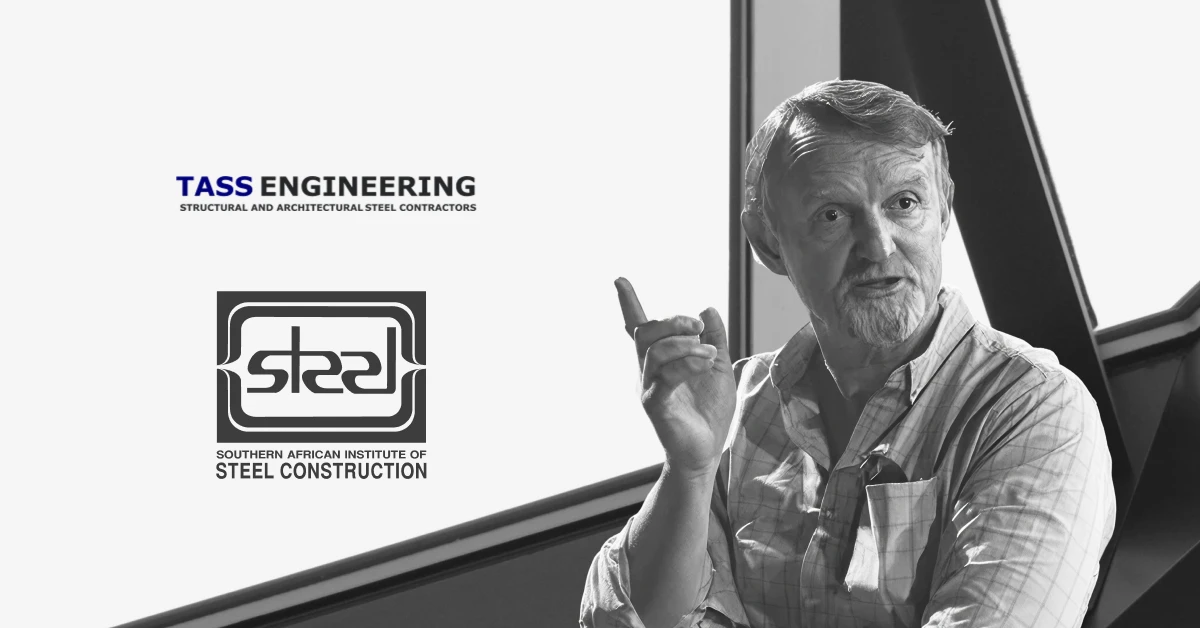
This article is based on a recorded interview with Tim Tasioulas, Managing Director of Tass Engineering and SAISC Board Member. His insights are shared in the interest of raising awareness and encouraging safer, more accountable practices across the steel value chain.