
As the African infrastructure landscape evolves, the traditional model of “product supply” is being replaced by a sophisticated, “solutions-based” approach. This shift represents a fundamental pivot in how South African manufacturers engage with the continent.
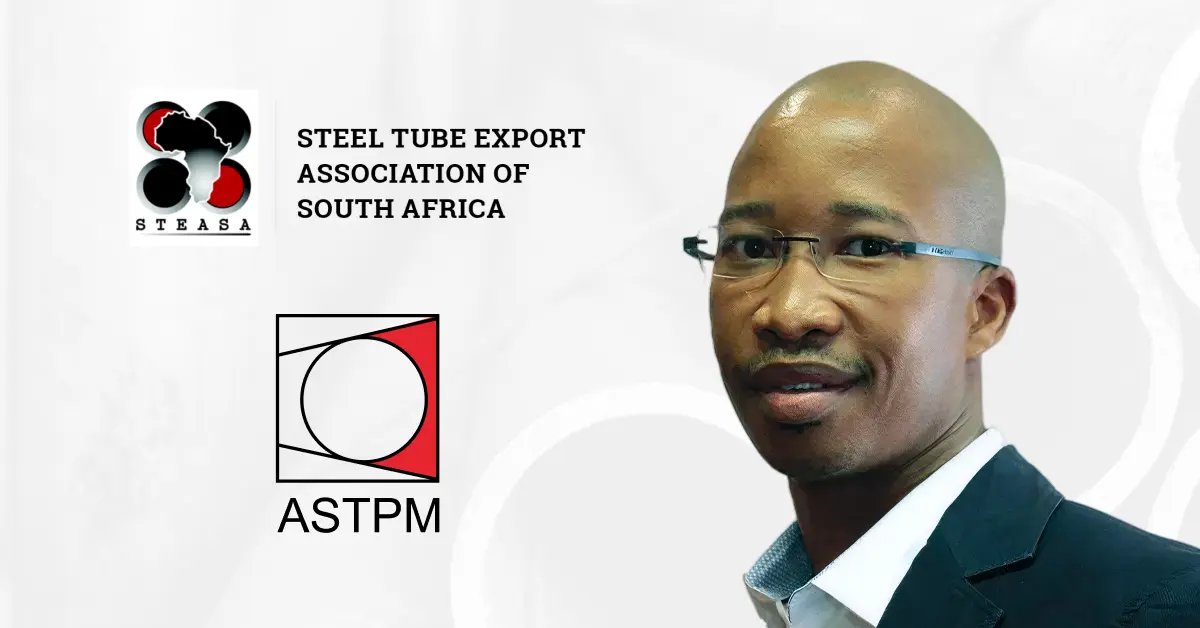
In a recent interview, Keitumetse Moumakoe, CEO of the Steel Tube Export Association of South Africa (STEASA) and Director of the Association of Steel Tube and Pipe Manufacturers (ASTPM), shared his insights on how innovation and uncompromising quality governance are positioning South African steel as the preferred choice for high-value African projects.
The new African demand shift from products to solutions
The African market is no longer a destination for basic raw materials alone. As different nations on the continent industrialise, there is a deliberate move toward local beneficiation. Moumakoe notes that while primary steel is still exported, there is a growing trend toward prefabricated components that are assembled at the destination.
This modular approach addresses two critical challenges:
Firstly, it is significantly easier and more cost-effective to transport precision-engineered components than massive, fully-assembled structures. Secondly, it allows destination countries to participate in the value chain through assembly and final fabrication, fostering a spirit of intra-Africa collaboration.
“A solutions-based approach allows you to bring in a lot of innovation and non-conventional ways of working on systems,” Moumakoe explains. “It’s about putting in the effort to say: ‘Let me provide a solution instead of just exactly the product you asked for.'”
The stringency of development finance
One of the primary drivers of high-performance steel demand is the nature of project ownership. Major trade corridors, bridges, and railways are increasingly funded by Development Finance Institutions (DFIs) such as the World Bank, Afreximbank, and the African Development Bank (AfDB).
For these institutions, there is no room for error. Their procurement processes are famously stringent, requiring world-class standards. In this environment, quality is the entry fee. South African exporters benefit from a decades-long track record of manufacturing to international standards, giving them a competitive edge over lower-cost but less reliable global competitors.
Innovation, particularly in high-growth sectors like renewable energy, requires extreme precision. Moumakoe highlights the solar and wind sectors as prime examples where “steel tolerances are very, very precise.”
Whether fabricating single-axis trackers for solar farms or structural components for wind turbines, the margin for error is non-existent. Weak quality assurance in these scenarios leads to compromised integrity that can lead to catastrophic collapses, project delays and penalties, as well as reputational damage. Once a source is labelled as a supplier of “inferior steel,” regaining market trust is an uphill battle that can take years to resolve.
Formal quality programmes
To protect the industry’s reputation, Moumakoe emphasises the importance of formal quality initiatives, such as those driven by the SAISC.
Programs like the Authorised Economic Operator (AEO) from SARS serve as examples of programmes that add customs integrity, in this case to both importers and exporters. Similarly, a quality programme can add integrity in the quality space where a “vetted” status acts as a green light for global project owners, signalling that a company’s fabrication methods, supply chains, and ISO certifications are fully compliant.
Moumakoe is adamant that quality outweighs price within reason. “If we take shortcuts and focus on price instead of quality, there will be consequences… we’ve seen structures go down because certifications were bypassed.”
Empowering emerging exporters
A critical role of STEASA, in partnership with the Department of Trade, Industry and Competition (DTIC) and The Council for Scientific and Industrial Research (CSIR), is ensuring that the “good group” of quality-compliant exporters continues to grow.
The association actively assists emerging exporters in obtaining necessary ISO certifications. By providing access to funding and technical guidance, they ensure that smaller players can enter the export market with the “right papers,” preventing them from being marginalised as “the naughty kid in the corner.”
Looking ahead: The webinar series
To bridge the information gap, STEASA is launching a series of webinars starting March 18, 2026, in collaboration with the SAISC and the Export Credit Insurance Corporation (ECIC).
The inaugural session will provide an overview of export credit solutions relevant to companies operating within the steel industry and related sectors. The discussion will focus on the role of trade finance in supporting responsible expansion into African markets and managing the financial risks associated with cross-border projects. Find out more information about the event and attend HERE.
The goal is to demystify the complexities of trade finance and risk mitigation. Many companies avoid the export market because they are unaware of the instruments available to cover political and commercial risks. By bringing designers, manufacturers, architects, and project owners together, these platforms aim to spark new innovative collaborations across the continent.
Conclusion
The future of South African steel exports lies in the intersection of innovation and integrity. By embracing a solutions-oriented mindset and adhering to the most stringent quality protocols, South African manufacturers are building the reliable backbone of a modernising Africa.
As Keitumetse Moumakoe aptly summarises: “When we promote South African steel, we are promoting a vetted pool of excellence. Who would want to be left out of that?”