


In business, as in life, it is easy to think that the problems and challenges we face are unique, that we are operating in isolation.
Each time I travel overseas, I am struck by just how connected global industries have become, and even more so, how similar the challenges we all face truly are.

My recent trip to New Zealand for the International Steelwork Contractors Group (ISCG) conference was no different and reinforced the importance of keeping our global networks and colleagues close, if not on speed dial.
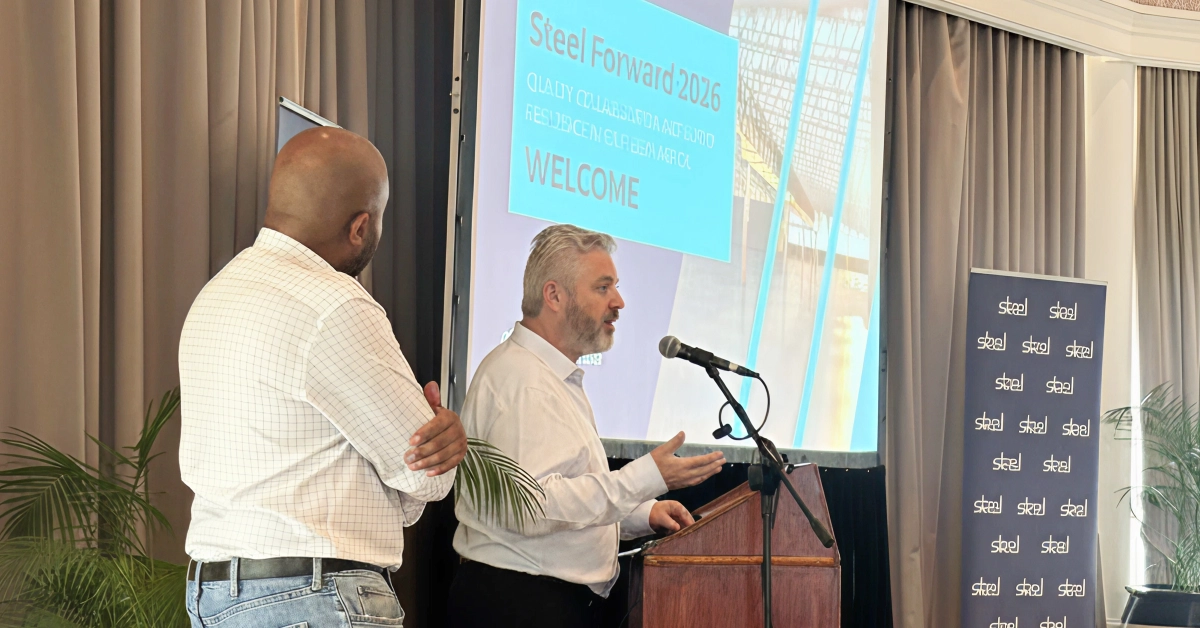
The ISCG is a forum of English-speaking steel institutes from around the world. Delegates from Canada, the UK, Australia, New Zealand, the United States and South Africa meet every two years to discuss technical challenges and emerging trends in the steel construction industry.
The most recent meeting was held in New Zealand in November 2025, following the previous gathering in Canada two years earlier.
I was privileged to attend both meetings, which allowed me to compare the market confidence, concerns and commentary across the various regions over that period.
At the most recent meeting, there was an overwhelming concern expressed by many attendees about the impact that the dumping of finished products is having on their local industries.
Fortunately, or unfortunately, this is a challenge the South African construction industry has been facing for several years. In fact, it was tabled by the South African delegation at the Canadian meeting two years ago.
Where we are fortunate as a local industry, in my opinion, is that while the challenge of deflated global prices on finished goods has in no way disappeared or even been alleviated, it is now a known issue. In many instances, end users have already “burnt their fingers” with non-regional supply chains grinding projects to a halt — a reality highlighted starkly during COVID-19 and the impact the pandemic had on live projects.
In these uncertain times, with several wars being fought and even more threatening to begin, the reality is that clients with established regional supply chains will be the least affected.
What I always emphasise in discussions with clients is this: when considering your supply chain for a project (whether comparing an overseas supplier or two local suppliers) the critical success factor is safe, reliable, on-time supply that fits together when it arrives on site. And when it doesn’t fit (because, let’s be honest, we’re all still human), the ability to pick up the phone, have a rational conversation, and have someone on site the same day or the next day becomes invaluable.
What does a few percent saving on upfront procurement really mean when your project is delayed by eight months because inferior materials failed on site, or a ship is stuck in port for six weeks due to flooding, or cannot leave the source port due to civil unrest? These are all very real examples that the SAISC receives calls about on a weekly basis.
Looking again to our international colleagues, many market areas are now beginning the process of applying for anti-dumping duties in an effort to halt the onslaught on their local industries. I was “encouraged” to note that the application process in these markets appears just as bureaucratic, slow and cumbersome, and most likely just as ineffective, as it is in South Africa.
My advice to the delegation was therefore not to place too much hope in anti-dumping applications being the industry’s hail Mary solution. Anyone who has run a workshop knows that continuity of work is what keeps a fabrication shop alive. A drawn-out legal process simply takes too long to offer any meaningful assistance to the fabrication sector.
So where does this leave the industry, and what does our outlook look like for the foreseeable future?
I would argue that we are in an extremely positive space.
I have long maintained that the South African construction industry is geographically well positioned to service the African continent. When combined with our intimate understanding of the African business landscape, the advantages of a local and regional supply chain become clear.
Taking direction from our UK and New Zealand colleagues, early engagement with key stakeholders and a partnership-based approach have proven to be significant differentiators in delivering successful projects.
As the Managing Director of Betterect, I can personally attest to this approach being instrumental in several highly successful projects completed over the past two years — projects that broke the norm in terms of being delivered on time and on budget. Surprisingly, however, this approach is still not readily sought after in much of the project and construction space.
Another notable difference observed from our New Zealand colleagues is a shift in how cost is assessed within the construction industry — focusing on the number of attachments on a component rather than a simple rand-per-kilogram comparison. This shift followed an education campaign led by the New Zealand steel institute, aimed at developers and designers, clearly demonstrating the impact on overall project time and cost when attempting to “lighten” a structure by downsizing member sizes, only to then add gussets and other attachments that significantly increase fabrication and installation time and cost.
The short version of this lesson is simple – simple and heavy is cheaper overall.
This again points to a deeper, more collaborative discussion that needs to take place across the supply chain to unlock hidden value — and it is a discussion that simply cannot happen without a genuine partnership approach between all stakeholders.
While 2025 brought its share of challenges, lessons and exciting opportunities, I remain cautiously optimistic about the year ahead and confident in how our extremely robust construction sector will navigate this evolving world.